
My experience with Booking.com
I first listed my own place on Booking.com a few years ago, in early spring. At the time, I was feeling a bit anxious because we didn’t have as many bookings as I would normally have expected by that point in the year. Looking back, I think that moment marked a wider shift in the market, when people started booking much more last minute.
At the time though, it just felt sensible and like the next move in broadening my horizons (having been listed on Airbnb for a good few years and taking bookings via Facebook, Instagram and Google too). I felt it was part of the journey and I wanted to see how it worked.
I wasn’t expecting it to be less admin. I’d already heard people say it could be quite difficult to use. What I was hoping for was access to different guests and a bit of wider reach.
Setting it up
There definitely wasn’t a honeymoon phase.
The listing itself was easy enough because I could carry it over from Airbnb. But I found intensely difficult to get the calendar and pricing settings right and cried in frustration more than once.
I also struggled to create an advert that properly represented my place. I felt I couldn’t personalise it in the same way, or explain the offer clearly.
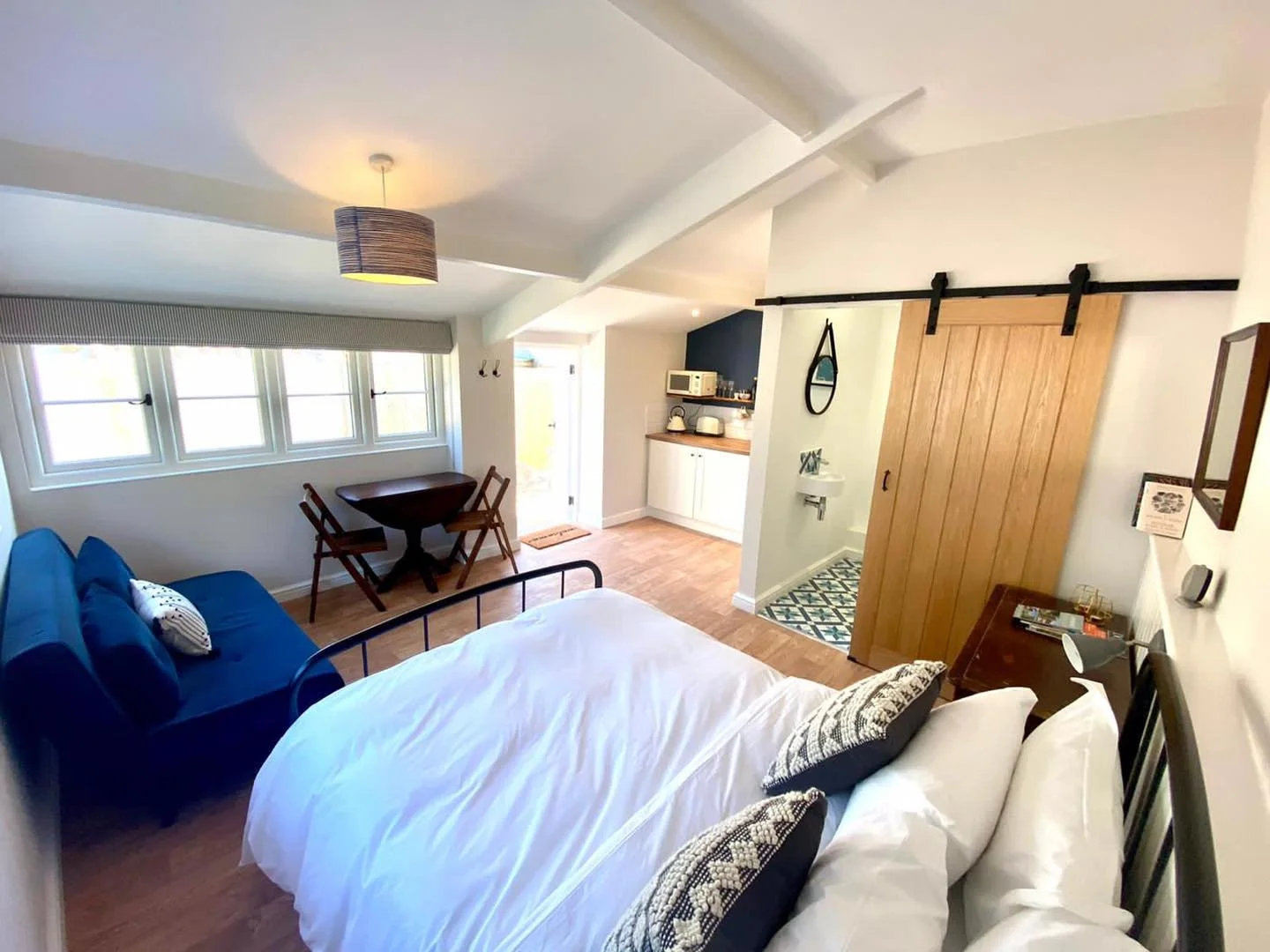
My place is tiny. We can sleep four, but only if the third and fourth people are under about four foot tall. When I was listed on Booking.com, I had a couple of occasions where four big men booked the space. It was completely inappropriate for them, but I didn’t feel I could properly explain both what the place was and what it wasn’t.
Communication and guest experience
One of the biggest surprises for me was the lack of communication. It felt like a polar opposite to Airbnb and Facebook, which were the main ways I was getting bookings at the time.
People would book and then not want to message at all. Sometimes I couldn’t get a message to them. They would arrive without having read directions or details or, more often, get lost and be a bit cross about it because our postcode doesn’t bring you to us. Getting guidebook information across felt difficult and that made me anxious.
My place is part of my home and while I don’t seek loads of interaction, I do like a bit of contact (even just a text). It helps set the tone and it makes me feel more comfortable about who’s coming into the space.
Managing guests through Booking.com always felt harder than elsewhere. I always get some nerves before a check in anywho, but that feeling was much stronger with Booking.com.
I also had some negative experiences with over-occupancy and rule breaking, such as smoking because they hadn’t read the rules (which are much harder to spot on Booking.com.)
Money and control
Financially, the bookings were fine once the calendar was working properly; entirely comparable with Airbnb and elsewhere.
But I don’t feel like I ever fully harnessed the power of the calendar. Pricing felt difficult. Some dates I undercharged. Some I thought were very good rates. I looked at pricing software like PriceLabs and Beyond and trialled them, but at the time you couldn’t link them to Booking.com. That felt like a real nag.
The stress made it much less valuable to me than the other platforms I was using.
In terms of control, I didn’t mind things like cancellations. I had a strict cancellation policy. I had one no-show and still got paid, which was actually quite cool.
Payments were fine. I never needed support, so I can’t comment on that side of things.
The type of guests
Being on Booking.com did change the type of guests we attracted.
We had more commercial bookings from people working in the area. We also had more European guests, which I really liked. Compared to Airbnb, and especially compared to Facebook, where we get none from abroad, that was a real plus.
I think my place isn’t a great fit for Booking.com. It’s rural, very small, cosy and quite unique. I think if you’ve got an inner-city apartment, it’s probably a very different experience altogether.
Deciding to stop
I had a niggle that it wasn’t quite right the whole time.
I stayed on for about six months, one full high season. By that point I was quite happy with the level of bookings, but the feelings of stress and discomfort never eased, despite the money coming in.
Eventually I realised it wasn’t necessarily bringing in additional income. I would probably have sold those nights on Airbnb or Facebook anyway. I just wasn’t enjoying the extra stress.
The decision to stop was slow, but when I actually switched it off, I definitely felt relief. Even if I had found the experience equally as straightforward as Air, I think it still wouldn’t have been the best choice for me as it meant another plate to spin, and I’m happier with fewer plates and the profits.
I also listed one of the places I co-host on Booking.com at the same time, and the experience was very similar. That was actually reassuring. I’d given it a fair go.
Looking back
The outcome was that it wasn’t for me. But it was still a really useful experience.
As a host, as a co-host and now as a coach, I’m really glad I tried it. If I hadn’t, I think I would always have wondered whether I should have done. Booking.com works brilliantly for some hosts. It just wasn’t the right fit for my business.
All of us need to do what works for us. What suits our property, our guests and our hearts too - there’s no fun in running a business that you don’t enjoy. It’s only as good as the lifestyle it affords you, in both financial and comfort terms.
What next?
If you feel like you would benefit from some tailored 1-2-1 support, I offer a number of services to improve your listing and help you gain confidence and clarity. Why not book a listing review with me to ensure you are getting the most out of your holiday let?
Kay x
P.S If you’re looking for confidence & clarity in every decision, weekly prompts, personalised input & feedback and a chance to grow in a community of wonderful, like-minded hosts, join Confident Host Circle, my online membership designed for women like you.