
Can your holiday let really be dog friendly if dogs aren’t allowed everywhere?
There is a difference between allowing dogs in your holiday let and genuinely welcoming them. But I don’t think being dog friendly means dogs have to be allowed everywhere.
At the large beach house I run, around half of our guests bring dogs and half don’t. Dogs are properly welcome, but they aren’t permitted upstairs or on the beds. We have carpeted bedrooms and we also want to welcome guests who don’t own dogs, don’t want bedrooms that smell of dogs or, like me, have allergies.
Some people would say that means we aren’t truly dog friendly. I disagree.
For me, making a holiday let dog friendly means thinking properly about what dogs and their humans need, making the practical bits easy and communicating the boundaries clearly. It doesn’t mean giving dogs the run of the entire house.
Think about what happens when the dog actually arrives
Before buying anything cute, think practically.
At my big house, guests have the code for the garage so they can reach the back garden without taking a muddy dog through the house. From there they can come into the utility room, where the dog towels and washing machine are.
Inside, there’s a stair gate that allows guests to stop their dogs physically going up the stairs.
We also have an outdoor dog wash, essentially a short hose with a spray attachment, so sandy or muddy dogs can be rinsed before coming inside.
Our garden is large, lawned and fully enclosed, with boundaries of around six feet. If you’re advertising an enclosed garden, I think it’s important to explain what that actually means. Dog owners need enough information to decide whether your garden will work for their particular dog.
The practical question is really this: how easy have you made it for guests to look after your property while looking after their dog?
Provide the things that make travelling with a dog easier
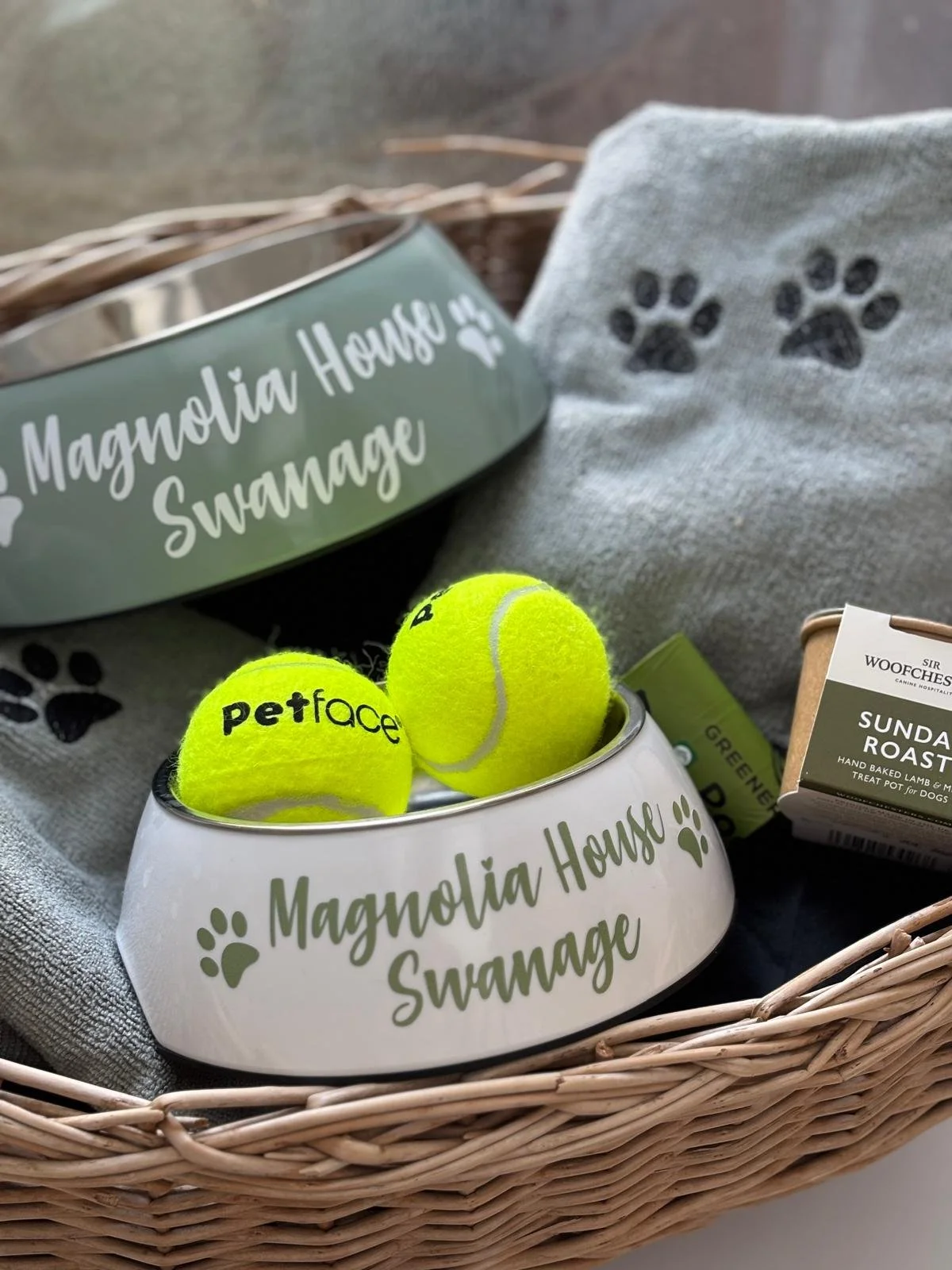
We leave a proper dog welcome hamper containing two dog towels with paw prints on them, a large blanket for the sofa, food and water bowls, poo bags, a ball or toy and a treat. It gets mentioned in most of the feedback from those guests bringing dogs.
I use these lovely personalised dog bowls from Etsy, and I’ve also put the dog towels, balls, poo bags and dog first aid kit I use into my Amazon dog storefront.
I don’t provide dog beds. They’re quite a personal choice, they’re bulky to store and most owners prefer their own. The blankets are a useful middle ground because guests can put them on the sofa if the dog wants to sit with the family.
That’s really the principle behind what I provide. I don’t want to fill the house with dog paraphernalia for the sake of it. I want to remove useful things from an already very full packing list.
Make the rules welcoming too
Clear rules don’t make a holiday let less dog friendly.
Our dogs are welcome throughout the downstairs and guests can use the blankets if they want them on the sofa. Dogs aren’t allowed upstairs or on the beds. We also ask that dogs aren’t left unattended in the house.
I’d much rather communicate that as:
Dogs are very welcome downstairs and we’ve provided blankets so they can curl up with you on the sofa.
than lead with:
DOGS MUST NOT GO UPSTAIRS.
Exactly the same rule. Completely different welcome.
I don’t charge extra for dogs either. There is invariably additional cleaning after they’ve stayed, but for me the extra cost is insignificant enough that I’d rather build it into the business. Adding another charge can put guests off and, worse, gives people an incentive not to add the dog to the booking at all. I’d much rather know they’re coming so we’re ready for them.
Answer the questions before guests have to ask
People travelling with dogs want the same thing every other guest wants: to know whether the place will work for them without having to send you six questions first.
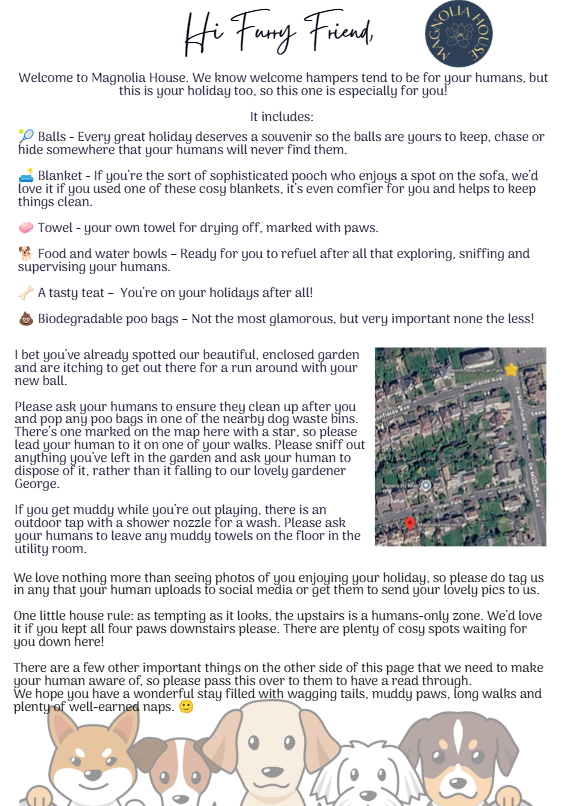
Inside our dog hamper is an A4 dog welcome sheet. One side gives the dog a proper welcome and explains where they can go, what they can do and where they’ll be safe. The other side is for their humans, with our dog rules, where to dispose of waste, nearby walks, dog friendly beaches and places to eat.
We’ve done the research so they don’t have to.
I’ve made my version into a template for you to adapt. Add your email to the form here to get the Canva and Word versions of that template, so you can choose whichever works best for you, as well as my completed version for you to use as inspiration.
I also try to personalise the welcome. If I know the dog’s name, I’ll include it in the handwritten card we leave for the family. It costs nothing, but it tells the guest that their dog wasn’t reluctantly accepted as an extra. We knew they were coming.
You don’t need to become a “dog property”
This is an important distinction for me.
My beach house isn’t a holiday let built around dogs. Our main market is multigenerational family groups, but in a big family gathering it’s quite likely that somebody owns a dog and wants to bring them.
Being properly dog friendly simply means that having that dog with them doesn’t make the holiday harder.
That has commercially worked well for us too. Around half of our guests bring dogs, yet the house doesn’t smell of dogs and it still works for plenty of guests who don’t own one.
Dogs haven’t caused us meaningful damage either. Cleaning does take longer after dogs have stayed, but good systems and clear expectations deal with most of the practical issues.
Dog friendly doesn’t have to mean dogs everywhere
For me, this is the crux of it.
You can protect carpeted bedrooms, keep dogs off beds and maintain parts of your property for guests who don’t want dogs around them, while still giving dogs and their owners a genuinely warm welcome.
Provide what they need. Make muddy arrivals easy. Give them somewhere secure outside. Tell them where they can go rather than only where they can’t. Research the places nearby that will welcome them too.
Being dog friendly isn’t simply saying: “Yes, you can bring one.”
It’s saying: “We knew you were bringing them, we’ve thought about what you’ll need and we’ve made it easier for all of you to have a brilliant stay.”
If you’re thinking more broadly about what genuinely dog friendly hosting looks like, or how to fully lean into any niche, you might also like my post What a truly dog friendly host would tell you.
And if you’d like a ready made starting point for your own dog welcome, download my dog welcome sheet via the form above.
Kay x
P.S. If you’re looking for confidence & clarity in every decision, weekly prompts, personalised input & feedback and a chance to grow in a community of wonderful, like-minded hosts, join Confident Host Circle, my online membership designed for women like you.
Please note that, as an Amazon affiliate, I earn from qualifying purchases made with the links above. I never recommend something I haven’t used myself.